
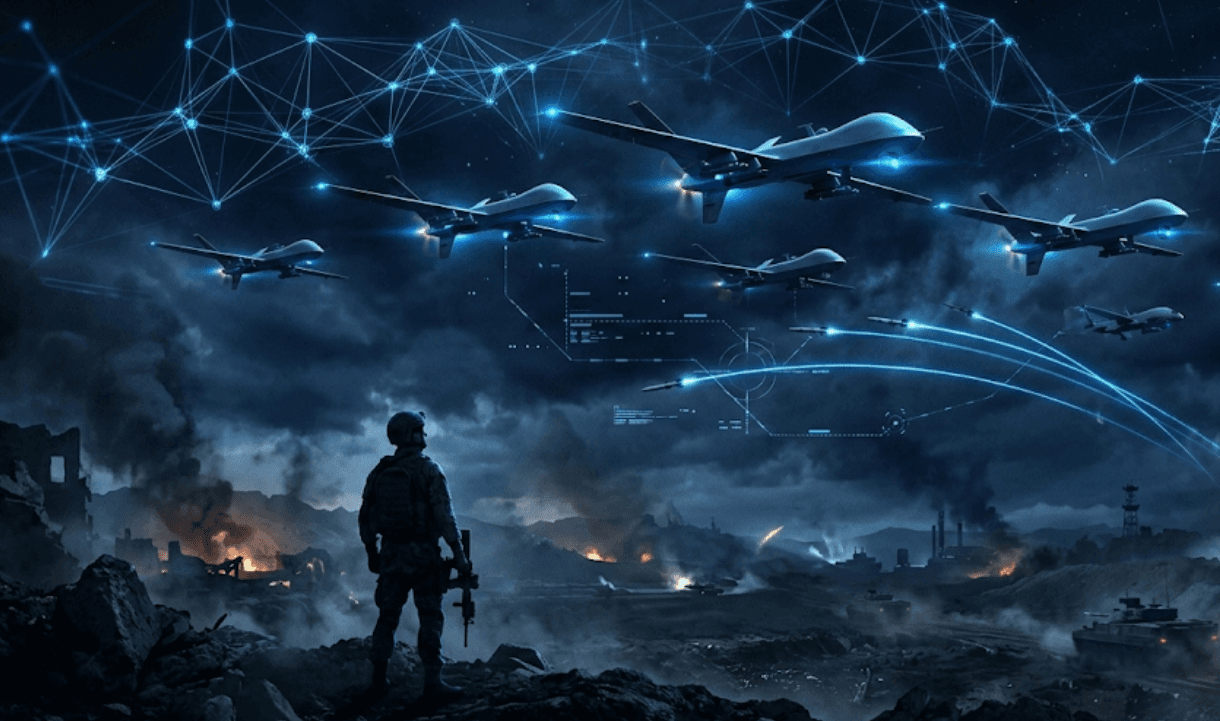
Artificial Intelligence in Modern Warfare: Scope, Applications, and the Inevitable Militarization of Emerging Technology

Author: Navneet Singh
AI Engineer and Cybersecurity Researcher | Ekoahamdutivnasti Technologies
Published: March 2026
Abstract
Every major technology in human history has eventually been turned into a weapon. From fire to electricity, from chemistry to nuclear physics, the pattern repeats without exception. Artificial Intelligence is the latest technology to follow this path, and in many ways it is the most consequential one yet. This paper looks at how AI is currently being used in military applications, what the realistic scope of its future use looks like, how it played a role in the Iran conflict, and why the weaponization of AI was never going to be avoided. It also explores what responsible AI weapons development could look like, drawing from my own experience building AI systems across civilian, security, and defence-adjacent domains.
1. Introduction
There is a pattern in human history that almost nobody talks about openly, but that becomes obvious the moment you look for it.
We discover fire and we burn things down. We understand electricity and we build electric chairs and power weapons factories. We split the atom and the first thing we do is drop two bombs on civilian cities. We build the internet, originally a military project, and it becomes the infrastructure for surveillance, cyberattacks, and mass propaganda.
Every single time, without exception, a new technology moves through the same stages. First it is a scientific curiosity. Then it becomes an industrial tool. Then someone figures out how to kill people with it. Sometimes this takes decades. Sometimes it takes years. But it always happens.
Artificial Intelligence is now at that stage. The question people keep asking is whether AI will be used in warfare. That question is already answered. It is being used right now. The better question is how far this goes, and whether anyone is thinking seriously about the consequences before it is too late to shape the outcome.
I am writing this as someone who builds AI systems professionally. I created Vrinda AI, a conversational AI assistant used by thousands of people. I built Vastav AI, India’s first deepfake detection system, registered under the Government of India copyright framework. I am currently developing Venom, an AI project with direct implications for how artificial intelligence intersects with human safety and decision-making in high-stakes scenarios. I am not a defence contractor or a military researcher. I am an independent AI engineer working out of India, and that position gives me a perspective on this topic that I think is worth sharing. The people building AI systems at the ground level see things that the policy discussions often miss.
2. What AI Is Actually Doing in Warfare Right Now
2.1 Intelligence and Surveillance
The most mature military use of AI today is in intelligence gathering and analysis. Modern AI systems can look at satellite imagery and spot things that would take a team of human analysts days to find. They process thousands of hours of drone footage in real time. They track patterns in communications data across entire populations.
The US military’s Project Maven is probably the most publicly known example. It uses deep learning to analyze drone footage and automatically flag objects of interest. Before this, you needed rooms full of analysts staring at screens. Now a single AI system handles what would have taken dozens of people, and it does it faster and more consistently.
China has gone further with this concept. The People’s Liberation Army has deployed AI surveillance infrastructure along its borders that combines facial recognition, behavioral pattern analysis, and predictive threat modeling. These systems pull data from an enormous camera network and build what military planners call persistent battlefield awareness.
When I built the facial recognition and verification components inside Vrinda AI, I was working with the same underlying technology stack that powers military surveillance systems, just applied to a completely different problem. The gap between a civilian AI assistant and a surveillance weapon is not as large as most people assume. It is mostly a question of what data you feed the system and what objective you train it toward. That proximity should make anyone building AI systems think carefully about what they are contributing to, even indirectly.
2.2 Autonomous Weapons
This is the category that makes people uncomfortable, and for good reason.
Israel’s Harop drone does not wait for a human to press a button before it strikes. It loiters over a target area, detects active radar emissions on its own, and dives into the source. The human decision was made when it was launched. After that, the machine handles everything.
South Korea has the SGR-A1 sentry system deployed along the demilitarized zone with North Korea. It uses computer vision to detect and track people, and it has the technical capability to engage targets without a human command, though the current policy requires human authorization for lethal action. That policy could change.
The US Navy’s Sea Hunter vessel can operate for months without any crew. It navigates autonomously, tracks submarines using AI systems, and represents a new category of military asset that has no human on board at all.
These are not future concepts. They exist today and they are deployed.
My work on Venom started from a specific question. If you are going to build AI-guided systems that operate with high autonomy in sensitive scenarios, what should the hard constraints be? The answer I kept coming back to was human detection. A system that can reliably identify the presence of civilians and abort its action is fundamentally safer than one that cannot, regardless of how capable it is in every other dimension. This seems obvious when you say it out loud. It is apparently not obvious to everyone building these systems.
2.3 Cyber Operations
AI has changed cyberwarfare significantly. Offensive AI tools can now scan millions of lines of code looking for vulnerabilities in a fraction of the time it would take human researchers. They can launch phishing attacks that adapt based on what worked and what did not. They can probe infrastructure around the clock without fatigue.
On the defensive side, AI systems monitor network traffic for anomalous behavior patterns that no human analyst could catch in real time. The attack and defense cycle in cyber operations now happens faster than humans can follow.
There is also a newer category called cognitive warfare. This uses AI to generate realistic fake content, manipulate information environments, and target specific populations with tailored disinformation. It is warfare against perception rather than infrastructure, and it does not require a single bullet.
Vastav AI exists precisely because of this threat. I built it to detect deepfakes, which are AI-generated synthetic media that can make anyone appear to say or do anything convincingly. When I was developing Vastav, I was constantly aware that I was working on the defensive side of a technology arms race that is already active in real conflicts. The same generative AI models that create deepfakes for entertainment are being used in active information warfare operations. Detecting them is not a niche research problem. It is a genuine national security issue, and most of the people in positions to address it at a policy level do not fully understand the technical landscape.
2.4 Command and Logistics
Less visible but equally important is what AI does behind the frontlines. Military logistics is enormously complex and AI handles optimization problems that would be impossible to solve manually. Supply chain routing, predictive maintenance for equipment, scenario simulation for command planning, coordination across land, sea, air, space, and cyberspace simultaneously.
The US Joint Artificial Intelligence Center has developed systems that give commanders predictive analytics on enemy behavior based on historical patterns and real-time data. This is not AI making decisions about who to attack. It is AI helping human decision makers understand their situation faster and more clearly than they could otherwise.
3. AI and the Iran Conflict
Iran represents one of the clearest real-world case studies for how AI is actually being used in modern military conflict, both as a target and as a participant.
3.1 The Soleimani Strike
The January 2020 strike that killed Iranian General Qasem Soleimani near Baghdad Airport was not a spontaneous operation. It required months of intelligence work, and that intelligence work was heavily supported by AI systems that processed location data, communication intercepts, and pattern of life analysis to predict where Soleimani would be and when.
This is what AI-assisted targeting looks like in practice. The AI did not decide to kill him. Human decision makers made that call. But the AI made the decision possible by processing volumes of data that no human team could have synthesized quickly enough.
3.2 The Israel-Iran Shadow Conflict
The ongoing covert conflict between Israel and Iran has become one of the most significant testing grounds for AI-enabled military operations in the world today.
Stuxnet is the early example that most people know. It was software that autonomously identified specific industrial control systems at Iran’s Natanz nuclear facility and sabotaged them without any human involvement at the point of execution. This was not modern AI in the current sense, but it established the operational concept of autonomous cyber weapons that act independently once deployed.
The 2020 assassination of Iranian nuclear scientist Mohsen Fakhrizadeh is a more recent and more troubling example. Reports describe a weapon system operated via satellite that used AI-assisted facial recognition to identify the target and execute the attack with minimal human involvement at the moment of the strike. If these reports are accurate, this was one of the first publicly documented uses of an autonomous lethal system using computer vision for target identification in an actual operation.
As someone who has worked directly with computer vision and detection systems, reading those reports was not an abstract technical exercise for me. The technology described is not exotic or classified. Versions of it exist in open source repositories. The barrier between a civilian computer vision application and a weapons-integrated targeting system is lower than most people outside this field realize. That should be part of the public conversation about AI regulation, and largely it is not.
3.3 Iran as an AI Warfare Actor
Iran is not only on the receiving end of this. The country has invested seriously in drone technology, and its drone swarm concepts have been demonstrated in regional proxy conflicts. It has conducted AI-supported cyberattacks against Israeli and American infrastructure. It has developed disinformation and synthetic media capabilities for psychological operations.
The Iran situation shows something important about where AI warfare is headed. Advanced AI military capability is not limited to the United States and China. Smaller states and even non-state groups can access and deploy AI tools that give them asymmetric capabilities far beyond what their conventional military resources would suggest. This is the same dynamic I see in the civilian AI space. A small independent developer in India can build systems that a few years ago would have required a large research team and significant institutional resources. The democratization of AI capability cuts in all directions at once.
4. Why This Was Always Going to Happen
4.1 The Historical Record
The list speaks for itself.
Fire became incendiary weapons. Chemistry became poison gas and chemical weapons. Physics became nuclear bombs and directed energy systems. Biology became bioweapons programs. Electronics became radar and jamming systems. Computers became the backbone of signals intelligence and cyberweapons. The internet became the infrastructure for global surveillance and information warfare.
Every single technology in this list started with scientific or peaceful applications. Every single one ended up being weaponized. There is no example in recorded history of a major technology that was not eventually applied to warfare. None.
Artificial Intelligence is more capable, more adaptable, and more general-purpose than any previous technology on this list. The idea that it would be the first exception to this pattern was never realistic.
4.2 The Arms Race Problem
Even countries that might genuinely prefer not to develop AI weapons face an impossible situation. If your adversary builds AI-guided weapons and autonomous systems and you do not, you will lose any conflict with them. This logic is understood by every military strategist on the planet, which is why every major military power is investing heavily in AI weapons development regardless of what their public statements say.
This creates a classic arms race where the rational decision for each individual actor is to develop these weapons, even if everyone would collectively be better off if nobody did. International agreements to limit AI weapons face enormous verification challenges because unlike nuclear materials, AI algorithms cannot be physically detected or contained. The same underlying technology that runs a commercial product can be repurposed for military use with relatively minor modifications.
I have experienced a version of this dynamic at a much smaller scale. When I was building Vastav AI, I was aware that the detection techniques I was developing could theoretically be inverted. Understanding how to detect a deepfake requires understanding how deepfakes are made. There is no clean separation between offensive and defensive knowledge in AI. Every researcher working on AI safety or AI security is simultaneously building knowledge that could be used to cause harm. You cannot opt out of that tension by choosing the right project title.
4.3 The Speed Problem
Human warfare has always been limited by how fast human beings can think and decide. AI removes that limit. Conflicts in the near future may involve exchanges that happen faster than any human being can perceive or respond to. Not because humans chose to remove themselves from the decision loop, but because the loop physically moves too fast for human participation.
This has serious implications for meaningful human control over lethal force, which is a foundational principle of international humanitarian law. Maintaining that principle becomes structurally difficult when the relevant decisions are happening in milliseconds.
5. The Ethical Problems That Nobody Has Solved
5.1 Who Is Responsible
When an autonomous system kills a civilian, current international law has no clear answer for who is legally responsible. The programmer who wrote the targeting algorithm? The officer who authorized the deployment? The government that bought the system? The company that built it? This accountability gap is not a theoretical future problem. It is an active problem right now for weapons systems that are already deployed.
5.2 Removing the Human Cost of Starting Wars
One of the things that historically slows down military escalation is that humans have to die on both sides. Autonomous systems change this calculus. A country that can conduct military operations primarily through autonomous weapons has reduced its own human cost for starting conflicts. This potentially makes it easier to begin military operations and harder to find the political will to stop them.
5.3 Attacks on Reality
AI-generated synthetic media creates a category of attack that has no real historical precedent. A realistic deepfake video of a head of state announcing surrender. Fabricated audio of military commanders issuing false orders. Synthetic intelligence reports designed to provoke specific responses. These are attacks on the information environment itself and they can trigger real violence without any physical weapons being involved.
This is the threat that motivated me to build Vastav AI. The capability to generate convincing synthetic media is widely available and improving rapidly. The capability to detect it reliably is lagging behind. That gap is a genuine vulnerability, not just for individuals being defamed or for entertainment platforms dealing with fake content, but for democratic institutions and military command structures that depend on being able to trust the information they receive.
5.4 Bias in Systems That Make Life and Death Decisions
AI systems are trained on historical data, and historical data contains human biases. When those systems are used for surveillance, threat assessment, and targeting, the biases in the training data translate into biased outcomes in the field. There is substantial evidence from facial recognition research that these systems perform worse on people with darker skin tones, which has obvious implications for who bears disproportionate risk when AI-assisted targeting is used in conflict zones with mixed civilian and combatant populations.
6. Building AI That Protects Rather Than Just Kills
The historical pattern does not mean there is no choice about how this plays out.
If AI is going to be integrated into weapons systems regardless, the people building those systems have a responsibility to ask what constraints should be built in from the start. This is not idealism. It is practical engineering applied to a problem that will exist whether or not engineers engage with it seriously.
This is where my work on Venom becomes directly relevant to this discussion. The core concept behind Venom is that an AI-guided system operating in a high-stakes environment should have civilian detection as a hard constraint, not an optional feature. Before any autonomous action is executed, the system checks for the presence of human beings in the affected area. If humans are detected, the action is aborted. The system does not proceed until that check is cleared.
The technical components required for this approach are available today. Computer vision systems can already identify human beings in real time with high accuracy under a range of conditions. The engineering challenge of integrating this reliably into an operational system is real but not insurmountable. The harder challenge is institutional. Military organizations are not naturally structured to accept constraints on the effectiveness of their weapons systems, even when those constraints serve clear humanitarian purposes.
Working on this problem from outside the defence establishment, as an independent developer in India rather than as an employee of a large defence contractor, gives me a different view of it. The decisions about how AI weapons are built are not being made exclusively by governments and militaries. They are being shaped by the assumptions, defaults, and design choices of the engineers doing the actual work. Those engineers have more influence over the ou